LinkedIn vs YouTube for Founders: The Data-Backed Platform Guide
80% of B2B leads from social come from LinkedIn. But YouTube videos generate views for years. Here's how to pick the right platform and when to add the second.
Here's a question that trips up almost every founder I talk to: "Should I be posting on LinkedIn or starting a YouTube channel?"
It sounds like a platform question. It isn't. It's a question about time horizon, production capacity, and what "success" actually means for your business right now.
Most content out there will tell you to do both. That's technically correct and practically useless advice for a founder who is already stretched thin. The real answer is a sequence — and getting that sequence wrong is exactly why most founders give up on content before it starts working.
The Baseline Numbers You Need to Know
Before we compare anything, let's anchor on what we're actually working with.
LinkedIn crossed 1.3 billion members in 2025 (LinkedIn). Of all B2B leads generated across social media, 80% come from LinkedIn — compared to 13% on X and 7% on Facebook (HubSpot). Traffic from LinkedIn converts at a 2.74% visitor-to-lead rate, nearly three times higher than Twitter or Facebook (HubSpot). LinkedIn Lead Gen Forms specifically convert at 13% — more than five times the industry average.
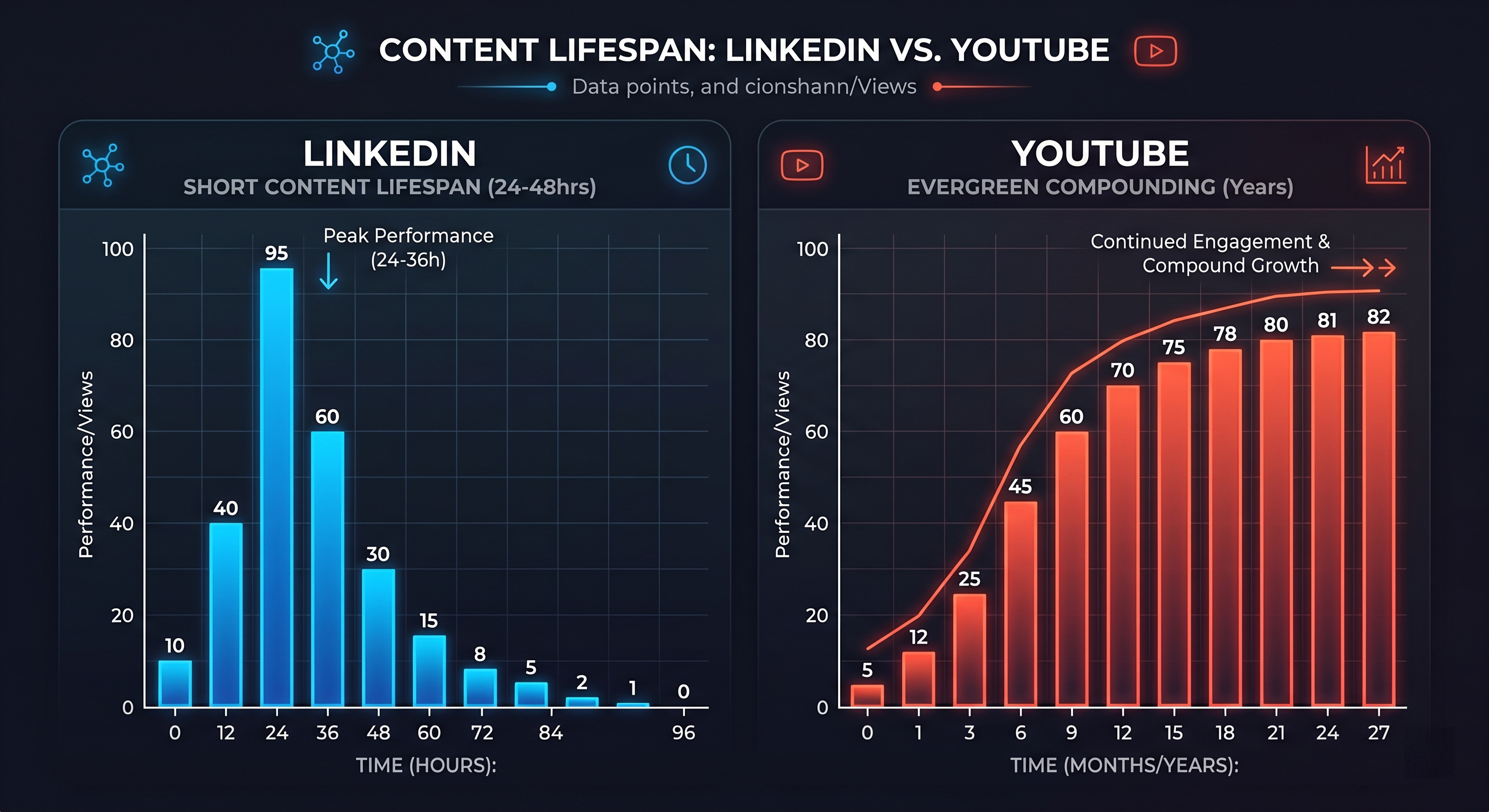
YouTube is a different animal. It's the world's second largest search engine, with 55% of consumers using it to research products before purchasing (Google/YouTube). Videos continue generating views and leads for months or years after posting — a well-optimised video on an evergreen topic can attract thousands of views annually, long after you've moved on to other things. The average LinkedIn post has a half-life of 24 hours. The average YouTube video has a half-life of 8.8 days — and that's just the average. Evergreen content compounds indefinitely.
Two very different assets. Two very different timelines. Here's how to think about which one you should build first.
6 Factors That Determine the Right Platform for Your Stage
1. Time to First ROI
If you need results in the next 90 days, LinkedIn wins. Full stop.
LinkedIn is a warm-network platform. When you post, your existing connections see it immediately. They already know who you are. One strong insight post can generate DMs, meeting requests, and inbound leads within 48 hours of publishing — especially if you're connected to people in your target market.
YouTube requires an audience before it generates leads. You're not posting to followers — you're posting to search algorithms. It typically takes 6 to 12 months of consistent publishing before a YouTube channel starts generating meaningful organic traffic. That's not a criticism, it's just the mechanics of how search-driven discovery works. For a Series A founder who needs pipeline now, that timeline is a problem.
LinkedIn is your short game. YouTube is your long game. Knowing which game you're playing determines which platform you start with.
2. Content Shelf Life
This is where YouTube's value proposition becomes undeniable.
A LinkedIn post has an active window of roughly 24 to 72 hours. After that, it disappears into the feed — not because the content was bad, but because the algorithm is built around recency. Every piece of content you publish on LinkedIn is effectively disposable. You're renting attention, not building an asset.
YouTube videos are search assets. A video explaining how to structure a founder pitch deck can generate views, subscribers, and inbound leads for three or four years after you recorded it. The production cost is one-time; the return compounds. This is why building a YouTube library is genuinely different from building a LinkedIn following — one is an investment, the other is ongoing operating cost.
For founders thinking beyond the next quarter, this shelf-life difference is enormous.
3. Audience Concentration
Where is your specific buyer?
For B2B founders selling to businesses — especially in SaaS, professional services, fintech, or any sector where the buyer is a decision-maker at another company — LinkedIn is where your audience lives and actively looks for solutions. 77% of B2B marketers say LinkedIn produces the best organic social results (Content Marketing Institute). LinkedIn is built for professional context — people are already in a business mindset when they scroll.
YouTube skews toward consumer behaviour, education, and how-to research. B2C founders, founders building developer tools, or anyone targeting buyers who self-educate before purchase will find YouTube's search-driven model fits the buying journey better. Founders in technical spaces — dev tools, AI, data infrastructure — also benefit disproportionately from YouTube because their audience actively searches for tutorial-style content.
Ask yourself: does my buyer search for solutions, or do they browse feeds? If search, YouTube. If feed-based discovery and network referrals, LinkedIn.
4. Production Cost
This is the factor nobody talks about honestly.
A LinkedIn post takes 20 to 45 minutes. You write it, you post it, you respond to comments. Even if you batch-produce a week's worth of posts, you're looking at a half-day of focused work. The format is forgiving — text, a single image, or a short video.
A YouTube video — done properly — takes 4 to 8 hours minimum when you account for scripting, recording, editing, thumbnail design, and optimisation. Some founders can compress this with AI tools and templates, but the fundamentals don't change: video is a high-production-cost medium. If you're not resourced for it, the quality gap between you and established creators in your niche will be obvious.
This isn't a reason to avoid YouTube forever. It's a reason to sequence correctly. Build the LinkedIn habit first. Once content creation is routine and you have support — whether that's a production partner or an AI avatar production workflow — then scale into YouTube.
5. Content Format and Your Natural Voice
Founders differ wildly in how they communicate best. Some are natural writers. Others are natural on camera. A few are better in conversation than either.
LinkedIn rewards text-first communication. Short punchy insights, structured "here's what I learned" posts, and contrarian takes perform well. Video on LinkedIn is growing (video watch time grew 36% year-on-year in 2025 per LinkedIn data), but it's still secondary to text-based content for most B2B audiences.
YouTube is exclusively video. You need to be comfortable on camera, or you need a workaround — slides-based content, screen recordings, or AI-generated avatars for founders who want the YouTube footprint without the camera exposure. The bar for comfort with video is non-negotiable.
Honest self-assessment here saves you months of forcing yourself into a format that doesn't suit you. If writing comes naturally, start on LinkedIn. If you're confident on camera and willing to invest in production quality, YouTube has a higher ceiling.
6. Long-Term Compounding
Thought leadership posts on LinkedIn generate 6x more engagement than job-related content (LinkedIn research). Executives who post regularly see up to 300% more engagement on their company pages. This compounds over time — but the mechanism is network growth, not search growth. You're building a following that grows because people follow people.
YouTube compounds through search authority. More videos → more indexed content → more search visibility → more subscribers → more views on new videos. It's a flywheel that takes longer to start spinning but is harder to compete with once it does.
LinkedIn gives you a platform with legs. YouTube gives you an asset with roots. Different compounding mechanisms, different timelines.
Platform Comparison at a Glance
| Factor | YouTube | |
|---|---|---|
| Content lifespan | 24–72 hours | Months to years |
| Time to first leads | Days to weeks | 6–12 months |
| B2B lead share | 80% of social B2B leads | Strong for search-driven buyers |
| Production time per piece | 20–45 minutes | 4–8+ hours |
| Audience mindset | Professional / networking | Research / education |
| Best content format | Text posts, short video, carousels | Long-form video, tutorials, series |
| Discoverability mechanism | Network + algorithm feed | Search engine |
| Compounding mechanism | Follower network growth | Search authority |
| Ideal for | B2B, pipeline, fast results | Evergreen, education, long-term brand |
| Barrier to entry | Low | High (camera + production) |
The Real Answer: A Sequenced Strategy, Not a Binary Choice
Every piece of content comparing LinkedIn and YouTube eventually says "do both." Here's the honest version of that advice.
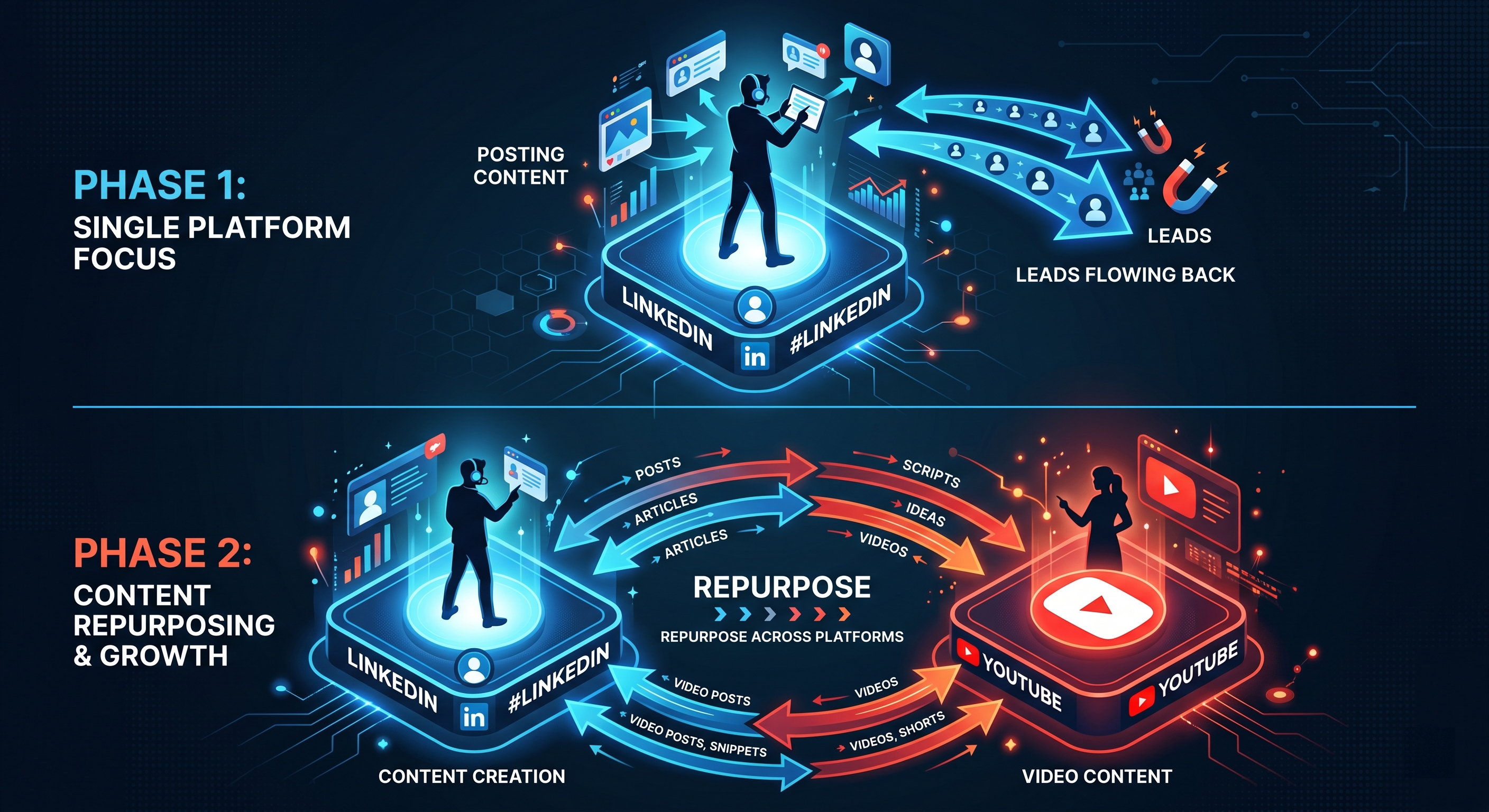
Phase 1 (Months 0–6): LinkedIn only. Post three to four times per week. Focus on original insights from your work, not reposts or generic takes. Build the discipline of regular publishing. This phase is about generating near-term pipeline while proving to yourself that content can produce results. When LinkedIn starts generating inbound consistently, you've validated that your content voice works.
Phase 2 (Months 6–12): Add YouTube strategically. Once LinkedIn is self-sustaining and you have support for production — a scriptwriter, an editor, or video production partner — introduce YouTube with a focused series. Don't start a YouTube channel with random videos. Start with 10 videos that each target a specific search term your ideal buyer types into Google. Evergreen, specific, useful.
Phase 3 (Month 12+): Repurpose across both. With both channels active, the content distribution flywheel starts working for you. YouTube videos get clipped to LinkedIn. LinkedIn posts become YouTube scripts. Your research and scripting investment gets amortised across multiple outputs. This is where the compounding really starts.
The mistake is trying to start both simultaneously without the production support to sustain either. Quality matters more than presence. One strong post per day on LinkedIn beats three mediocre posts; one well-researched YouTube video per week beats daily uploads that say nothing.
Common Mistakes Founders Make
Treating LinkedIn like a broadcast channel. LinkedIn rewards conversation. Founders who post and don't respond to comments, or who only share company news, miss the point entirely. The platform's algorithm amplifies posts with early engagement — meaning your first 60 minutes of replies matter enormously. Block time to respond.
Starting YouTube before the fundamentals are in place. The graveyard of founder YouTube channels that stopped after 8 videos is enormous. If you don't have a clear thesis for the channel, a realistic production schedule, and at least 20 video ideas banked before you start, you're setting yourself up to quit. Don't start without infrastructure.
Using the same content on both platforms. A LinkedIn post pasted into a YouTube video description is not a YouTube strategy. These are different formats for different intent. LinkedIn content is timely, opinionated, conversational. YouTube content is evergreen, structured, and built around search intent. Cross-pollinate ideas, not formats.
Optimising for followers instead of leads. A LinkedIn following of 500 highly-relevant potential buyers is worth more than 10,000 followers in the wrong industry. Similarly, a YouTube channel with 2,000 subscribers in your exact niche will outperform a channel with 50,000 subscribers of mixed intent. Resist the vanity metrics.
Skipping the research and scripting phase. The highest-performing LinkedIn posts and YouTube videos share one trait: they're built around a specific insight or angle, not a general topic. "Lessons from hiring our first 10 engineers" beats "tips for startup hiring" every time. Specificity is what makes content shareable, quotable, and remembered.
Frequently Asked Questions
Can I start LinkedIn and YouTube at the same time?
You can, but most founders shouldn't. Running both channels simultaneously requires consistent output in two very different formats — short text posts multiple times per week on LinkedIn, plus a production-quality video on YouTube. Without a content team or production partner, quality drops on both. The sequenced approach — LinkedIn first, YouTube added once LinkedIn is producing results — produces better outcomes for resource-constrained founders.
How often should founders post on LinkedIn?
The data suggests three to five times per week is the sweet spot for consistent LinkedIn growth. Daily posting works, but only if quality doesn't suffer. It's better to post four genuinely useful insights per week than seven filler posts. Consistency over volume — the algorithm rewards accounts that post regularly, not accounts that post frantically for two weeks then go quiet for a month.
How long until LinkedIn starts generating leads?
Most founders see meaningful inbound within 60 to 90 days of consistent, targeted posting — provided they're connected to their target audience. The key word is targeted. If your network is full of people outside your buyer profile, LinkedIn will generate engagement but not leads. Actively connecting with potential buyers in your target market is as important as the content itself.
Is YouTube worth it for B2B founders?
Yes, but with caveats. YouTube works best for B2B founders selling to technical buyers or buyers who extensively self-educate (SaaS, developer tools, fintech, legal tech, etc.). For founders selling primarily through relationships and referrals — professional services, consulting, high-ticket enterprise — LinkedIn will produce higher ROI per hour of content effort. YouTube is a long-term investment. Go in with that expectation.
What kind of LinkedIn content performs best for founders?
Contrarian takes and lessons from experience consistently outperform generic advice. "What I got wrong about hiring" beats "5 tips for hiring." First-person narratives with specific outcomes — "we tried X, here's what happened" — generate significantly more engagement than instructional content without context. Thought leadership from personal experience, not aggregated wisdom, is what LinkedIn's audience responds to.
Do I need to be on camera for YouTube?
No. Slides-based presentations, screen recordings, and AI avatar-generated videos are all viable alternatives for founders who prefer to stay off camera or want to scale their YouTube output without scheduling individual recording sessions. Tools like HeyGen allow you to create a digital avatar once and generate video content at scale. The production quality bar is lower than most founders assume — what matters is whether the content is useful, not whether you look like a polished broadcaster.
How do LinkedIn and YouTube work together long-term?
The most efficient content flywheel for founders treats YouTube as the origin asset and LinkedIn as the distribution channel. You publish a well-researched 8-minute YouTube video on a specific topic. Then you clip the best 60 seconds for a LinkedIn video post, write a LinkedIn text post expanding on the main argument, and share a carousel summarising the key points. One piece of research and scripting investment produces four pieces of content across two platforms. This is how you scale content without scaling time.
Building a content engine across two platforms doesn't have to happen overnight. If you're early-stage, start with LinkedIn — it's the highest-ROI investment per hour of content work for most B2B founders. When you're ready to add YouTube, make sure you have the production infrastructure to do it properly.
At Akatsys Studio, we help founders build both — from scripting and research through to video production and distribution — so you're not reinventing the wheel every time you create something. Book a free Brand Audit and we'll tell you exactly where to start.