Why Every Startup Founder Needs a Personal Brand in 2026 (And How to Build One)
82% of people trust a company more when its CEO is active on social media. Here's the complete founder's guide to building a personal brand that attracts investors, talent, and inbound leads.
Before your next investor meeting, someone is Googling you. Before a top engineer decides whether to apply, they're checking your LinkedIn. Before an enterprise buyer signs a contract, they're watching your content to decide if you actually know what you're talking about.
Your company has a brand. But in 2026, the people who matter to your business are betting on you — the person behind it. And if there's nothing there to find, you're handing a compounding advantage to every competitor who is showing up.
This is the complete guide to building a founder personal brand from scratch: why the data is unambiguous, exactly how to do it, what kills it, and how AI tools have removed the one excuse that used to hold founders back.
Why a personal brand is no longer optional
The numbers on this are stark.
82% of people trust a company more when its CEO and leadership team are active on social media (Weber Shandwick). Not marginally more — meaningfully more. Trust is the primary currency in every sale, hire, and fundraise you'll ever make.
44% of a company's market value is directly tied to the CEO's reputation (Weber Shandwick). For an early-stage company where the product is still unproven, that number skews even higher.
74% of B2B buyers say a founder's thought leadership content influences their decision about who to trust (Edelman B2B Thought Leadership Report). And 60% of decision-makers say thought leadership directly contributed to awarding business (Edelman). Not influenced — directly contributed.
There's also a data point most founders overlook: only 1% of LinkedIn's 1.15 billion users post content weekly — yet that 1% generates 9 billion impressions per week. The space is not crowded. Most of your competitors are spectators.
What "personal brand" actually means for a founder
Strip away the marketing language and it's simple: making your thinking visible to the people who matter to your business.
It's not a polished persona. It's not motivational quotes. It's publishing your genuine perspective on the problems your customers have, the industry you're in, and the lessons you're learning as you build. When you do this consistently, you create a permanent, compounding record of your expertise that works for you 24 hours a day — including while you're asleep.
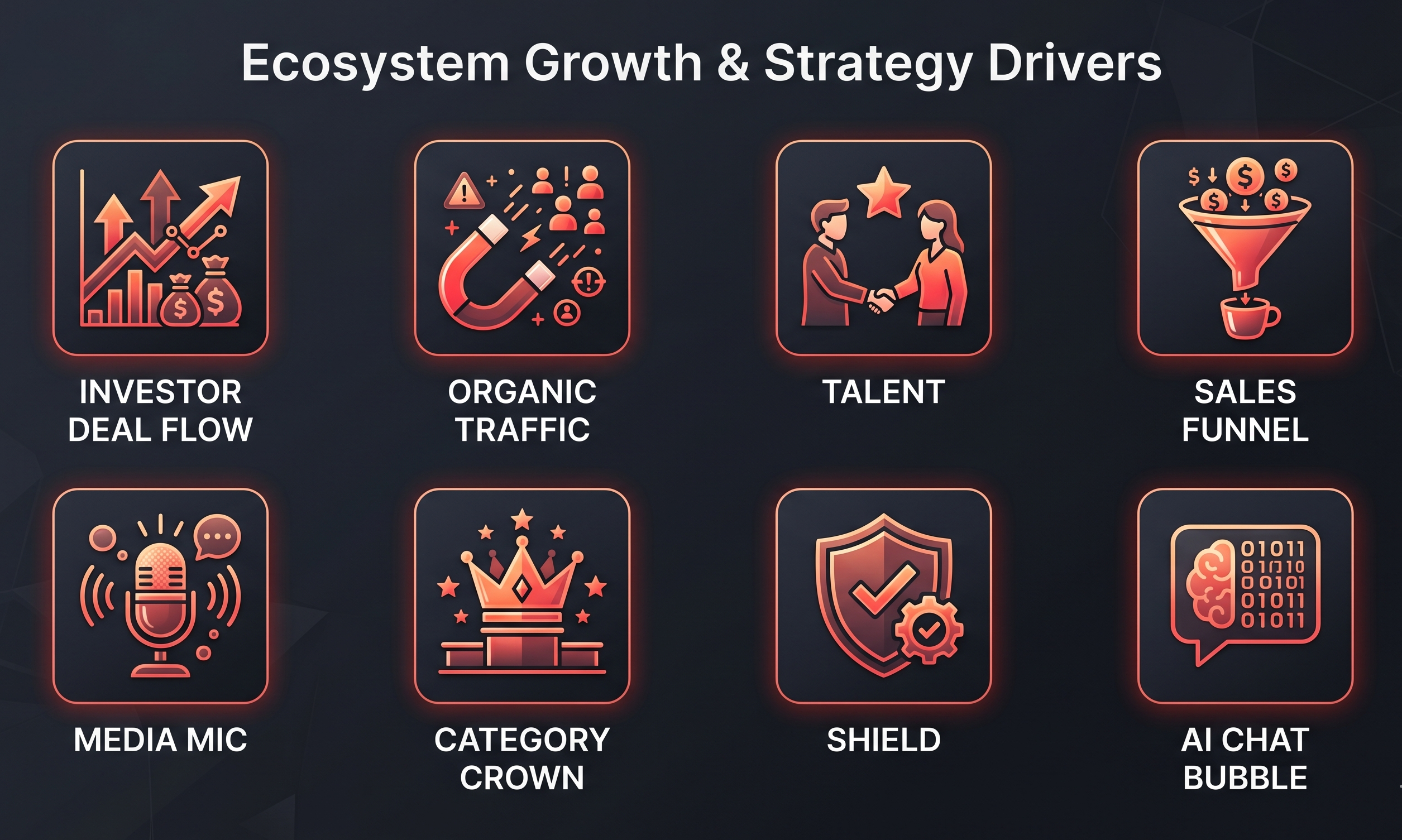
The 8 things a personal brand actually delivers
Before the how-to, let's be specific about what this actually gives you:
1. Inbound investor deal flow. VCs research founders before they reach out. A founder with a credible content presence has a permanent advantage in every fundraising conversation — you're not a cold name in a pitch deck, you're someone they already have context on. This is the most underrated benefit and the one competitors cover least.
2. Organic customer acquisition. Content ranks in search. A well-optimised YouTube video or blog post from 18 months ago is still sending you qualified leads today. That's leverage no paid ad budget can replicate indefinitely.
3. Talent attraction. The best engineers and operators have options. They choose founders they want to learn from. Publicly visible, credible thinking is your best recruiting asset before you ever post a job. 70% of employers say personal brand is now more important than a resume (LinkedIn data).
4. Sales cycle compression. When a prospect has consumed your content, they arrive at the first meeting already convinced you understand their problem. The conversation skips credibility and goes straight to logistics. Research shows personal branding shortens sales cycles by an average of 30%.
5. Media and press. Journalists need named experts to quote. If you've been consistently publishing on a topic, you're findable and quotable. Cold PR outreach converts at a fraction of the rate of inbound journalist interest — and inbound only comes to people who have published something.
6. Category ownership. In most markets, one or two voices own the category conversation. The founder who shows up consistently becomes the reference point everyone else gets compared against. That positioning compounds over years and is almost impossible to replicate quickly.
7. Crisis protection. A strong personal brand is a buffer. When something goes wrong — a product launch fails, a negative press cycle hits — founders with established credibility and an audience who trusts them navigate it incomparably better than founders who show up as strangers in a bad headline.
8. AI search visibility. This is the one gap almost no one is talking about. When someone asks ChatGPT, Perplexity, or Claude "who are the experts in [your space]?" — the answer is drawn from published content. If you haven't published anything substantive, you don't exist in AI search. If you have, you get cited. The window to establish a first-mover position in AI-generated answers is open right now. It won't stay open.
How to build a founder personal brand: a 7-step framework
Step 1: Define your positioning before you create anything
The most common founder mistake is jumping to content without knowing what they stand for. Before you publish a single thing, answer three questions:
- Who specifically are you talking to? Not "founders" — "B2B SaaS founders raising their Series A" or "DTC brand operators dealing with rising CAC."
- What's the one problem you understand better than most? Your positioning should be rooted in hard-won experience, not general expertise.
- What's your contrarian take? The content that travels is the content that challenges a widely-held belief. If you agree with everyone, no one has a reason to follow you.
Write one sentence: "I help [audience] with [problem] by [your unique angle]." That's your brief. Every piece of content you publish should trace back to it.
Step 2: Choose one platform and go deep
The biggest time trap is trying to be everywhere at once. Pick one platform and dominate it before expanding.
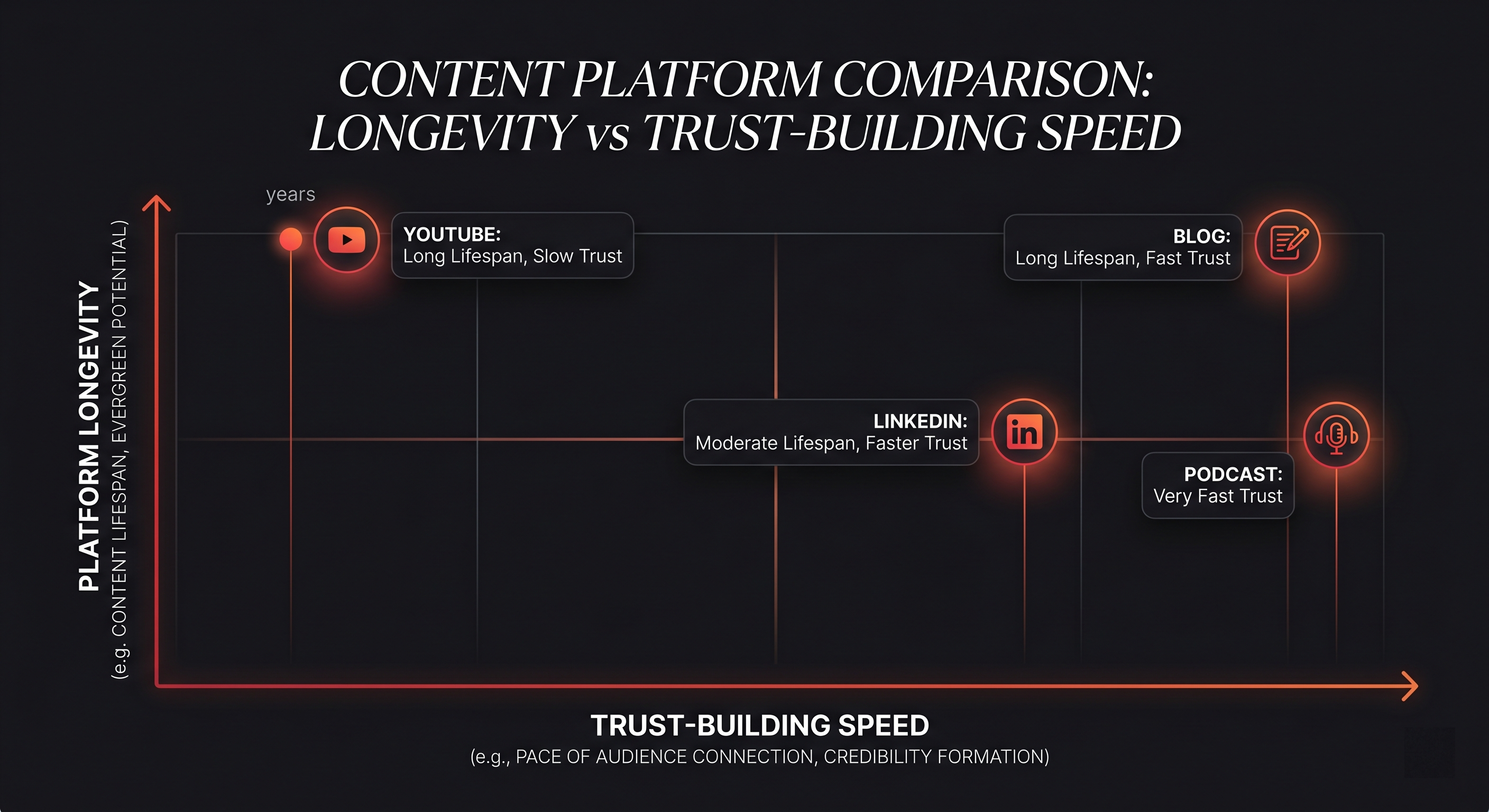
YouTube is the highest-leverage platform for most founders. It combines search intent (people find you when they're actively looking for answers) with deep trust-building (video builds rapport faster than any other format). YouTube content compounds — a video you publish today will still generate views in three years. Founders with professional video production support can maintain a weekly YouTube presence in under an hour of their time.
LinkedIn is the best B2B platform for immediate results. Executive posts get 2x more engagement than company page posts (LinkedIn Business data) — always use your personal account. LinkedIn content has a 48–72 hour shelf life but generates fast feedback. Fastest path to results in 30–60 days.
Step 3: Build a repeatable content system
Consistency beats quality every time. A solid video every week for 12 months will outperform a masterpiece every quarter. The founders who sustain output long enough for it to compound don't do it through willpower — they have a system:
- A documented content framework (what topics you cover, what you don't)
- A production workflow that doesn't require reinventing the process every session
- Someone else handling editing, distribution, and repurposing
The question isn't "can I create content?" — every founder can. The question is "can I create consistently enough for it to compound?" That's where most people stop.
Step 4: Batch your creation time
Recording one video a week is unsustainable for a founder running a company. Recording four videos in an afternoon once a month is very sustainable.
Batching works because the mental context-switching cost is the expensive part. Once you're in "content mode" — script approved, camera on, talking head warmed up — you can produce 4× the output with 1.5× the time. One 30-minute approval session per week with a production partner produces a full content calendar.
Step 5: Repurpose everything across formats
One piece of content should not stay in one format. A single long-form YouTube video becomes:
- 3–5 short-form clips (YouTube Shorts, LinkedIn, Instagram Reels, TikTok)
- A LinkedIn post (the core argument in text form)
- A Twitter/X thread (the framework or takeaways)
- A blog post (SEO-optimised written version)
- An email newsletter entry for your existing audience
This is how founders with limited time maintain a high-output content presence — they don't create more, they distribute better. Each repurposed asset targets a slightly different audience and search intent.
Step 6: Use AI tools to close the time gap
The biggest blocker between founders and consistent content used to be time. That constraint has largely been removed.
AI avatar production tools like HeyGen allow founders to record once, clone their voice and likeness, and produce professional video content indefinitely without additional recording sessions. One 30-minute session, then your AI avatar handles future video production while you stay on brand. This isn't about faking authenticity — the ideas, perspectives, and experiences are entirely yours. The production friction is what gets removed.
Research and scripting means you don't stare at a blank page. You approve a direction, review a draft, record — or let your avatar record. The time investment drops from hours per piece to 20–30 minutes of review.
Step 7: Measure the right things
Vanity metrics are poor leading indicators. The metrics that tell you whether your personal brand is working:
- Inbound mentions — are people referencing your content in conversations, intros, or outreach you didn't initiate?
- Sales meeting quality — do prospects arrive already knowing who you are?
- Unsolicited inbound — are investors, partners, or candidates reaching out without prompting?
- AI citations — search your name or primary topic in ChatGPT and Perplexity. Are you showing up?
These take 3–6 months to materialise. That's normal. Founders who give up at month 2 are the ones measuring follower growth instead of business outcomes.
What platform should you start on?
| Platform | Content Lifespan | Trust-Building Speed | Best For | Weekly Time (with help) |
|---|---|---|---|---|
| YouTube | 2–5 years | Slow (3–6 months) | SEO, deep authority, inbound | 1–2 hrs |
| 48–72 hours | Fast (30–60 days) | B2B network, immediate reach | 30–60 min | |
| Twitter / X | 2–6 hours | Medium | Real-time takes, community | 15–30 min |
| Personal Blog | 2–10 years | Slow | SEO, AI citations, long-form | 1–2 hrs per post |
| Podcast | 1–3 years | Very fast | Niche authority, relationships | 1–2 hrs per episode |
For most early-stage founders: LinkedIn for the first 90 days, then add YouTube once you have a repeatable script workflow.
Common mistakes founders make
Starting with aesthetics, not substance. A logo, a new headshot, a polished website — none of it matters if you have nothing substantive to say. Define your positioning first (Step 1), then worry about how it looks.
Treating it like marketing. Promotional content about your product builds an audience of nobody. Content that genuinely helps people — "here's exactly how I solved this problem" — builds an audience of future customers, investors, and hires.
Posting once and quitting. The first 3 months produce almost nothing. Most founders quit at month 2, right before the inflection point. The minimum viable commitment is 6 months of weekly output. There is no shortcut around this.
Delegating the thinking. You can delegate production, editing, distribution, and research. The one thing you cannot delegate is your perspective. Ideas and opinions that don't reflect your genuine thinking will be exposed quickly — and will undermine the credibility you're trying to build.
Ignoring AI search. If you're not publishing substantive content that gets indexed, you won't appear when AI tools surface experts in your space. In 2026, this is a real and growing channel — and the cost of acting early is low while the opportunity is still wide open.
Confusing output with strategy. Posting frequently without a clear positioning (Step 1) just produces noise. Before creating anything, know exactly who you're talking to and what you uniquely stand for.
Frequently asked questions
How long does it take for a founder personal brand to show results?
Realistically, 3–6 months before you see meaningful business outcomes — inbound investor interest, improved pipeline quality, or unsolicited outreach. LinkedIn typically shows results faster (30–60 days of consistent posting) than YouTube (3–6 months for search traction to build). The founders who give up at month 2 are the ones measuring follower counts instead of business impact.
How much time does this actually take per week?
With a production partner handling scripting, editing, and distribution, most founders spend 20–45 minutes per week reviewing and approving content. Without one, plan for 3–5 hours per piece. That gap is exactly why most founders bring in outside support — the time cost of doing it well without help is too high to sustain alongside running a company.
Does personal brand actually affect fundraising?
Yes — and it's one of the most underrated benefits. VCs research founders before they reach out. A founder with a credible, visible content presence provides pre-qualification that a cold pitch deck never can. Investors pattern-match on "does this person know what they're talking about?" — and consistent thought leadership content answers that question before the first meeting.
Do I need to be on every platform?
No. Start with one platform and do it properly. LinkedIn is the fastest path to B2B results. YouTube has the best long-term compounding effect. Pick one, commit for 6 months, then expand. Mediocre presence across five platforms is worse than an excellent presence on one.
Is it worth doing if my company already has a strong brand?
Yes — the ROI is often higher, not lower. Company accounts reach 2–6% of their followers organically. Personal profiles reach 8–15%. Branded content shared through founder accounts gets 24× more reach than the same content on a company page (MSLGroup research). The two work together, not in competition.
What if I'm not comfortable on camera or don't have time to write?
Neither is a blocker. Writing can be researched and drafted, then refined with your input — your job is to review and approve, not write from scratch. Camera discomfort fades with repetition. And for founders who truly can't commit to recording, AI avatar production removes the camera requirement entirely after a single 30-minute setup session.
Can I use AI to generate my personal brand content?
You can use AI for research, scripting drafts, and production workflow. But the ideas, opinions, and experiences need to be genuinely yours. An AI-generated opinion that doesn't reflect your actual thinking will be exposed quickly and is worse for your brand than saying nothing. Use AI to eliminate production friction — not to replace your voice.
What's the single most important thing to get right?
Consistency. The strongest personal brands in any industry aren't the most polished or most talented — they're the most consistent. Show up weekly with something genuinely useful to say for 12 months. Almost nothing else matters as much as the compounding effect of showing up reliably over time.
Akatsys Studio handles research, scripting, production, and distribution so founders can maintain a high-output content presence in under an hour a week. If you want to see exactly what we'd build for you, book a free Brand Audit.